
'Future market gains will likely depend primarily on earnings growth.'

Strategic affairs experts express concern over US President Donald Trump's tariffs on India, his 'bullying tactics,' and increasing attempts to hyphenate New Delhi with Islamabad, signaling a potential shift in the bilateral relationship.

The employment situation remains dire. Whatever can be done to promote greater low-skill employment should be pursued aggressively, advises former chief economic adviser Shankar Acharya.

The disbursement of the second tranche comes on a day when the International Monetary Fund is holding virtual discussions on Pakistan's upcoming budget, as the visit of its mission to Islamabad was delayed due to security concerns in the region.

The Reserve Bank of India has kept the key short term lending rate (repo rate) unchanged at 7.25%.
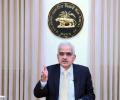
The challenge for the RBI in 2024 is likely to be less about containing elevated inflation and more about curbing excessive financial market exuberance and a 'problem of plenty', notes Sajjid Chinoy, Chief India Economist JP Morgan.

The Reserve Bank on Friday raised the inflation projection for current fiscal year to 4.8 per cent from 4.5 per cent with Governor Shaktikanta Das saying lingering food price pressures are likely to keep headline inflation elevated in the December quarter. Consumer price index (CPI)-based inflation increased sharply in September and October 2024 led by an unanticipated increase in food prices.

Announcing the bi-monthly monetary policy, Reserve Bank of India Governor Shaktikanta Das said the RBI's internal survey says manufacturing, services and infrastructure sector firms are optimistic of the business outlook.

Nestle India was the top laggard in the Sensex pack, shedding around 2 per cent, followed by SBI, HDFC Bank, Axis Bank, ICICI Bank, Reliance Industries, HUL and Dr Reddy's. NSE Nifty slipped 20.10 points to 15,670.25.

The Reserve Bank of India on Friday raised the GDP growth projection for the current fiscal to 7 per cent from 6.5 per cent earlier on buoyant domestic demand and higher capacity utilisation in the manufacturing sector. Announcing the bi-monthly monetary policy, RBI Governor Shaktikanta Das, however, flagged protracted geopolitical turmoil and global economic fragmentation as risks to the growth outlook. The RBI kept interest rates unchanged at 6.5 per cent in Friday's monetary policy statement.

Richard Clarida's recent paper could be key for policymakers in deciding whether India should move to an 'inflation targeting policy regime', says Vivek Dehejia.

Investor wealth eroded by Rs 4.46 lakh crore in a single day on Friday with the benchmark BSE Sensex tanking more than 1 per cent in line with global stocks rout. The 30-share BSE Sensex plunged 885.60 points or 1.08 per cent to close at 80,981.95 with 25 of its components declining and five ending with gains. During the day, it nosedived 998.64 points or 1.21 per cent to hit an intra-day low of 80,868.91.

The Reserve Bank of India's (RBI's) interest rate decision, West Asia conflict and trading activity of foreign investors are the key factors that will dictate investors' sentiment in the market this week, analysts said. Moreover, quarterly earnings from IT bellwether TCS, domestic macroeconomic data and movement in global oil benchmark Brent crude would also guide trends in the market. Worsening tensions in the Middle East and foreign fund outflows were the major culprits behind the equity markets sharp fall last week.

Gold prices hit a fresh record high of Rs 84,900 per 10 grams in the national capital on Friday, driven by robust domestic demand and strong global cues, according to the All India Sarafa Association. The precious metal of 99.9 per cent purity continued its ascent for the third straight session, jumping by Rs 1,100 to hit a new peak of Rs 84,900 per 10 grams.

From the 30-share pack, Adani Port, Bharti Airtel, Asian Paints, IndusInd Bank, Bajaj Finserv, Reliance Industries, Infosys, UltraTech Cement, HDFC Bank, HCL Technologies and ICICI Bank were among the laggards. Tata Motors, Axis Bank, Maruti, Larsen & Toubro, ITC and Tata Steel were among the gainers.

Moody's Investors Service on Friday raised India's growth projection for 2023 calendar year to 6.7 per cent on account of robust economic momentum. "Strong services expansion and capital expenditures propelled India's 7.8 per cent real GDP growth in the second (April-June) quarter from a year ago. "We have accordingly raised our 2023 calendar year growth forecast for India from 5.5 per cent to 6.7 per cent," Moody's said in its Global Macro Outlook. - el nino

The Indian economy is expected to be "a little weaker" in 2025 despite steady global growth, IMF managing director Kristalina Georgieva has said. Georgieva also said she expects quite a lot of uncertainty in the world this year mainly around the trade policy of the US. In her annual media roundtable with a group of reporters on Friday, she said global growth is expected to be steady in 2025, but with regional divergence.

US President Donald Trump has announced a 25 per cent plus tariff on India from Aug 1. Trump, describing India as a "friend", said the US has done relatively "little business" with the country because of its high tariffs.
The Indian economy is recovering from the slowdown in momentum witnessed in the September quarter, driven by strong festival activity and a sustained upswing in rural demand, according to a Reserve Bank of India (RBI) bulletin released on Tuesday. An article on the 'State of the Economy' in the December bulletin noted that the global economy continues to exhibit resilience with steady growth and moderating inflation.

Gold, a safe-haven bet, is likely to continue its record-smashing journey in the New Year, rising to Rs 85,000 per 10 grams and even Rs 90,000 level in domestic markets if geopolitical tensions and global economic uncertainties continue.

Moody's Ratings on Wednesday said India's economic growth will exceed 6.5 per cent in the next fiscal, up from 6.3 per cent this year, on higher government capex and consumption boost from tax cuts and interest rate reduction. Projecting a stable outlook for the banking sector, Moody's said although the operating environment of Indian banks will remain favourable in the next fiscal, their asset quality will deteriorate moderately after substantial improvements in recent years, with some stress in unsecured retail loans, microfinance loans and small business loans.

'Higher interest rates make gold less attractive as it doesn't generate yield.' 'However, with rates set to fall, the tables are turning for gold.'

Continuing the downward trend, retail inflation fell to a five-month low of 4.31 per cent in January, mainly due to a decline in the prices of vegetables, eggs, and pulses. The Consumer Price Index-based retail inflation was 5.22 per cent in December and 5.1 per cent in January 2024. The previous low inflation was in August 2024 at 3.65 per cent.

In a tightening cycle, a premature pause in monetary policy action would be a costly policy error, Reserve Bank Governor Shaktikanta Das opined while voting along with five other members of the MPC for raising the key lending rate by 35 basis points earlier this month, according to the minutes of the meeting released on Wednesday. Prior to the December hike in repo rate, the RBI had raised the key short-term lending rate by 190 bps in four tranche.

The International Monetary Fund (IMF) has said its executive board granted $1 billion in assistance to Pakistan this month after finding out that the country met all conditions and targets for it.

The wholesale inflation rose to a 13-month high of 1.26 per cent in April fuelled by rising prices of food articles, especially vegetables, amid expectations of RBI holding interest rates in the policy review next month. The wholesale price index (WPI) based inflation has been rising for two months in a row.

IndusInd Bank was the top gainer in the Sensex pack, rallying over 4 per cent, followed by SBI, Bajaj Finance, Bharti Airtel, Axis Bank, Sun Pharma, HDFC and PowerGrid.

Among the Sensex firms, Adani Enterprises and Adani Ports sustained their gaining momentum and traded higher by 4.40 per cent and 4.37 per cent, respectively. BPCL, Axis Bank, Mahindra & Mahindra and SBI were the other major gainers. On the other hand, HCL Tech, Infosys and Bajaj Auto traded in the negative zone with a loss of up to 1.54 per cent.

Volatility is likely to continue in the stock market this week amid Omicron uncertainty and the RBI monetary policy meeting will be a key driver for benchmark indices going ahead, say analysts. It will be an event-packed week for the markets, with RBI policy and several macroeconomic numbers scheduled to be announced, they added. "Volatility is likely to continue amid Omicron uncertainty, RBI credit policy, and macroeconomic numbers. "There are lots of news flows on the Omicron variant which are causing volatility in the market while on the domestic front we will have the outcome of an important monetary policy of RBI that is scheduled on December 8. "We will also have our IIP and inflation numbers this week however they will be released on Friday after market hours," said Santosh Meena, Head of Research, Swastika Investmart Ltd.

President-elect Donald Trump's warning that BRICS countries will face 100 per cent tariffs if they choose to move away from the US dollar is unclear to what extent he will carry out his threat, as it remains to be seen if the US laws permit such an action, former RBI Governor Duvvuri Subbarao said on Monday. He also said even for BRICS, there are internal differences about bringing out an alternative to the US dollar.

The domestic stock market may face volatility amid the monthly derivatives expiry scheduled this week, while investors would mainly await the outcome of RBI's interest rate decision on Friday, said analysts. Global market movement would also continue to drive sentiment amid a bearish trend recently following rate hikes by the US Federal Reserve and other central banks. The Reserve Bank of India (RBI) may take cues from its global counterparts to raise interest rate for the fourth time in a row to control inflation.

From the 30 Sensex pack, State Bank of India, Mahindra & Mahindra, Bharti Airtel, Titan, HDFC Bank, IndusInd Bank, Axis Bank and Bajaj Finance were the biggest laggards. JSW Steel, Tech Mahindra, Larsen & Toubro, Hindustan Unilever, HCL Technologies and Reliance Industries were among the gainers from the pack.
The Reserve Bank is likely to maintain status quo on interest rates in its forthcoming monetary policy review but may change the stance in view of retail inflation piercing its upper tolerance limit, global uncertainties created by the ongoing Russia-Ukraine war, and the urgency to protect and boost growth, feel experts. The RBI governor-headed rate setting panel -- Monetary Policy Committee (MPC) -- will be holding its first meeting of the 2022-23 fiscal from April 6 to 8. The outcome will be announced on April 8.

The IMF on Tuesday projected a growth rate of 6.1 per cent for India in 2023, which is a 0.2 percentage point upward revision compared with the April projection. This is reflective of the "momentum" from stronger-than-expected growth in the fourth quarter of 2022 as a result of stronger domestic investment, the International Monetary Fund (IMF) said. "Growth in India is projected at 6.1 per cent in 2023, a 0.2 percentage point upward revision compared with the April projection," it said in its latest update of the World Economic Outlook.
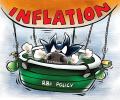
The Reserve Bank of India on Friday raised the retail inflation target for the current financial year to 5.7 per cent on the back of rising global prices amidst the ongoing geo-political tensions, even as it expected the prices of cereals and pulses to soften on prospects of good winter crop harvest. "Global food prices along with metal prices have hardened significantly. "Economy is grappling with a sharp rise in inflation... Inflation is now projected at 5.7 per cent in 2022-23 with Q1 at 6.3 per cent; Q2 at 5 per cent; Q3 at 5.4 per cent and Q4 at 5.1 per cent," RBI Governor Shaktikanta Das said while unveiling the first monetary policy review for the current fiscal year.

Manufacturing activities in India fell to a five-month low in September as new orders rose at a softer pace, which tempered production growth, a monthly survey said on Tuesday. The seasonally adjusted S&P Global India Manufacturing Purchasing Managers' Index (PMI) fell to 57.5 in September, down from 58.6 in August -- the lowest in five months. The September PMI data pointed to an improvement in overall operating conditions for the 27th straight month.

'When Prime Minister Modi met President Trump, they agreed to initiate a bilateral trade dialogue.' 'It makes sense to give these negotiations a chance.'

The finance ministry expects a broad-based moderation in inflationary pressures on the back of an anticipated reduction in food prices as a result of the uptick in summer sowing. The retail inflation rate remained stubbornly clung to the 5 per cent mark in seven of the past eight months. "Core inflation is trending downwards, indicating a broad-based moderation in price pressures... Driven by strong domestic growth and benign global commodity prices, core inflation is declining continuously.
Growth remains weak, inflation is within 2-6% range, rate cut would help recoup forex reserves

The US Federal Reserve's interest rate decision is the biggest event that would drive sentiments in the domestic stock market this week, besides a host of macroeconomic data from the global front and trading activity of foreign investors, analysts said. The Indian equity market had an exceptional last week, with both the Nifty and Sensex hitting their all-time high levels on Thursday.
